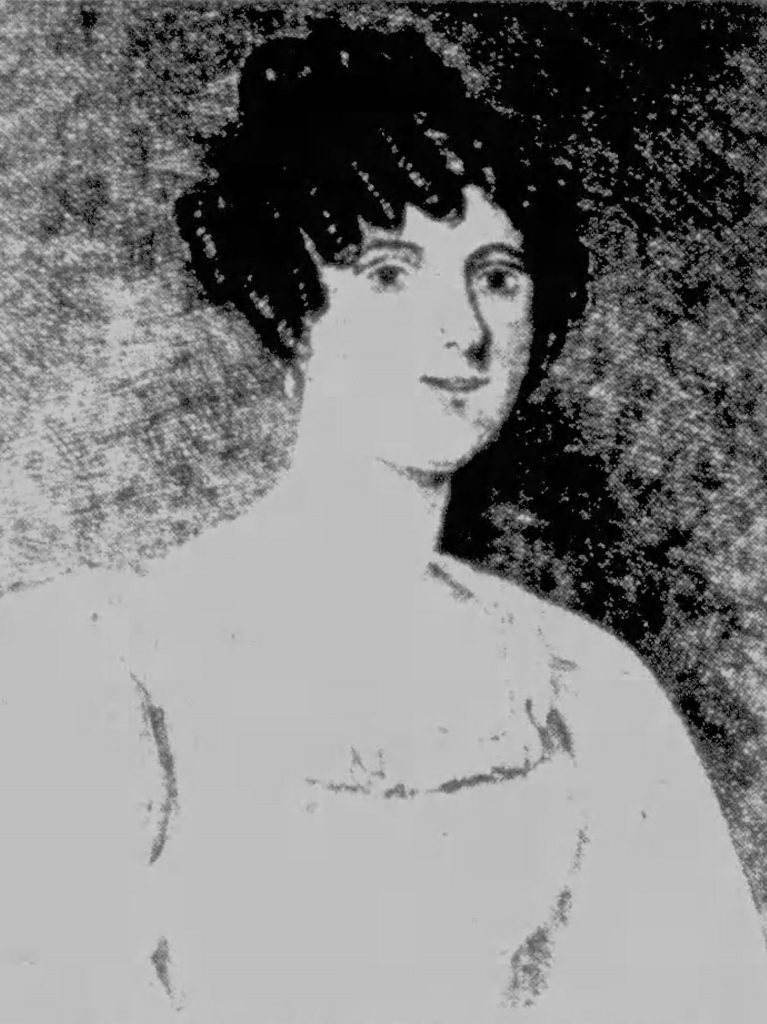
Ann Radcliffe: The Mother of the Gothic Novel
In Jane Austen’s Northanger Abbey, the young clergyman Henry Tilney makes a confession that surprises the heroine. “I have read all Mrs. Radcliffe’s works,” he says, “and most of them with great pleasure. The Mysteries of Udolpho, when I had once begun it, I could not lay down again; I remember finishing it in two days, my hair standing on end the whole time.”
Austen expected her readers to know exactly whom Henry meant. In the 1790s, Ann Radcliffe was the most popular novelist in England and one of the best-paid writers of her century. Critics called her a “mighty enchantress” and the Shakespeare of romance writers. Gothic fiction itself was known as the “Radcliffe school.” Yet the woman behind those castles and veiled portraits was so private that one reviewer said nothing was known of her but her name on the title page.
A shy child from a family in trade
Ann Ward was born in Holborn, London, on July 9, 1764. She was the only child of William Ward, a haberdasher, and Ann Oates. In 1772 the family moved to Bath, where her father managed a shop selling goods made by Josiah Wedgwood and his partner Thomas Bentley. Bentley was Ann’s maternal uncle, a well-off gentleman, and she spent long visits at his home in Chelsea and later at Turnham Green. Wedgwood remembered her as “Bentley’s shy little niece.”
Her uncle owned many paintings and prints of ruins and picturesque views. The scenery in her novels owes much to painters such as Claude Lorrain and Salvator Rosa.
Marriage and a writing life after dark
In 1787, at twenty-three, Ann Ward married William Radcliffe in Bath. He was also the child of a haberdasher. He had studied law without finishing and turned to journalism. The couple moved to London, where William worked for the radical Gazetteer and New Daily Advertiser. By most accounts the marriage was happy. She called him her “nearest relative and friend.”
According to a biography published after her death, she began writing to amuse herself while William worked late into the evenings. Her first novel, The Castles of Athlin and Dunbayne, appeared anonymously in 1789. Reviewers found it improbable. She kept going.
The early romances
A Sicilian Romance followed in 1790, credited only to “the authoress of The Castles of Athlin and Dunbayne.” It is a short, fast book. Julia, daughter of the tyrannical Marquis Mazzini, flees an arranged marriage and hides in her family’s castle. Strange lights and sounds haunt the abandoned southern apartments. The source turns out to be human. Julia’s mother, long believed dead, has been imprisoned there for years by the Marquis. The Oxford World’s Classics introduction says that here Radcliffe “began to forge the unique mixture of the psychology of terror and poetic description” that defined her later work.
Her real breakthrough came with The Romance of the Forest in 1791. A debt-ridden Parisian, Pierre de la Motte, flees his creditors with his wife and is handed a terrified young woman, Adeline, by a stranger. The party takes shelter in a ruined abbey in the forest, where Adeline finds a hidden manuscript written by a prisoner from 1642. The novel went through four editions in three years. Its second edition was the first to carry her name.
The Mysteries of Udolpho
The book that made her famous appeared in four volumes on May 8, 1794. Her publishers, G. G. and J. Robinson, paid £500 for the copyright, a sum far beyond what most novelists received.
The Mysteries of Udolpho follows Emily St. Aubert, a young woman of Gascony in 1584. After her parents die, she falls into the care of her cold aunt, who marries the Italian adventurer Montoni. He carries them off to his remote castle of Udolpho in the Apennines. Emily hears music in the night, and a door in her bedroom will not lock. In one room hangs a black veil, and when Emily lifts it, she faints at what she sees. Radcliffe makes the reader wait hundreds of pages to learn what was behind it.
The answer, when it comes, is a wax figure of a decaying corpse. That is the Radcliffe method in miniature. Her novels build dread from things that seem supernatural, then explain them in natural terms near the end. Critics call this the “explained supernatural.” Walter Scott admired her but disliked the device. Once a reader learns that the stealthy step behind the arras was only the cat, he wrote, “the solemnity of the feeling is gone.”
Radcliffe had reasons for her choice. In an essay published after her death, “On the Supernatural in Poetry,” she drew a line between terror and horror. “Terror and Horror are so far opposite,” she wrote, “that the first expands the soul, and awakens the faculties to a high degree of life; the other contracts, freezes, and nearly annihilates them.” What frightens us most, in her view, is the thing we cannot yet see.
Oddly, Radcliffe had never visited Italy or southern France. Her only trip abroad, to Holland and Germany, came in 1794, after Udolpho was written. Her Apennines came from paintings and books.
The Italian and the answer to The Monk
In 1796 Matthew Gregory Lewis published The Monk, a novel full of murder, sexual violence, and an open pact with the devil. It caused a scandal. Radcliffe’s reply came in December 1796, though its title page reads 1797. The Italian, or the Confessional of the Black Penitents is widely read as a rebuttal to Lewis.
In Naples in 1758, the young nobleman Vincentio di Vivaldi falls in love with Ellena di Rosalba, a poor orphan. His proud mother objects and turns to her confessor, Father Schedoni. Ellena is kidnapped and held in a convent. Vivaldi is arrested on false charges and handed to the Inquisition in Rome. Schedoni, cold and calculating, is often called her finest villain, and critics trace his influence to the brooding Byronic heroes of the next generation. Like Udolpho, the novel paints Catholicism in a hostile light, as many British Gothic novels did.
Her publishers, Cadell and Davies, paid £800 for The Italian. That made Radcliffe the highest-paid professional writer of the 1790s. It was the last novel she published in her lifetime.
Twenty-six quiet years
At the height of her fame, Radcliffe stopped publishing. Inheritances from her father, who died in 1798, and her mother, who died in 1800, freed her from any need to write for money. She and William traveled around England nearly every year, and she kept writing poems and a last novel, Gaston de Blondeville.
Her silence fed rumors. Some readers thought she had died or gone mad. After her death, William published a rebuttal, saying she could be seen every Sunday at church and almost every fine day in Hyde Park.
Radcliffe suffered from asthma in her later years. In early 1823 she caught a chest infection after a visit to Ramsgate. She died in London on February 7, 1823, at fifty-eight, and was buried at the Chapel of Ease of St George’s, Hanover Square. Gaston de Blondeville and the essay on terror and horror appeared in 1826.
Her influence, from Austen to Poe
Austen wrote Northanger Abbey in the late 1790s, and it appeared in 1817, after her death. Its heroine, Catherine Morland, devours Udolpho and then imagines Gothic crimes in the Tilney family home. The book teases the Radcliffe craze, but it never sneers at novel readers. Henry Tilney’s love of Udolpho is one sign that he is the right man for Catherine.
The Romantics read her closely. Byron, Coleridge, and Wordsworth all knew her work, and Scott called her one of “the founders of a class, or school.” Mary Shelley recorded in her journal that she read The Italian in 1814, a few years before Frankenstein, and she later referred to it in The Last Man. Critics have found Radcliffe’s terror in Victor Frankenstein’s disturbed dreams.
Her reach extended through the nineteenth century. Scholars trace her tradition to Jane Eyre and Wuthering Heights, and to Dickens, Hawthorne, and Poe. In “The Oval Portrait,” Poe describes a chateau as one of those piles of gloom and grandeur that have “so long frowned among the Appenines, not less in fact than in the fancy of Mrs. Radcliffe.” Fyodor Dostoyevsky recalled lying awake as a small child, listening as his parents read her novels aloud, “agape with ecstasy and terror.”
The literary historian Michael Gamer credits her with inventing “the psychological novel of suspense and the supernatural.” Any story that keeps its monster offscreen, letting a creaking door do the work, owes her something.
How to start reading Radcliffe
Radcliffe’s style is leisurely. She stops for sunsets and the heroine’s poems. Read her on long evenings, and the slowness becomes part of the spell.
Begin with A Sicilian Romance, which is short and moves quickly. Then read The Romance of the Forest to see her method mature. When you are ready, take on The Mysteries of Udolpho. It is long, but it is the book every later Gothic writer knew. Finish with The Italian, her tightest plot and her best villain. Then reread Northanger Abbey. Austen’s jokes land much harder once you have lifted the black veil yourself.
Her novels are in the public domain, and Project Gutenberg offers free texts.
Ann Radcliffe left behind few letters and no journals. What she left instead was the modern idea of suspense: a locked door, a distant scream, and a reader who cannot stop turning pages.
Sources
- Wikipedia: Ann Radcliffe
- Wikipedia: The Mysteries of Udolpho
- Wikipedia: The Italian (Radcliffe novel)
- Wikipedia: A Sicilian Romance
- Wikipedia: The Romance of the Forest
- Wikipedia: Northanger Abbey
- “Ann Radcliffe.” Encyclopaedia Britannica.
- Norton, Rictor. Mistress of Udolpho: The Life of Ann Radcliffe. Leicester University Press, 1999. (Cited via Wikipedia.)
- Talfourd, Thomas Noon. “Memoir of the Life and Writings of Mrs. Radcliffe,” in Gaston de Blondeville. Henry Colburn, 1826. (Cited via Wikipedia.)
- Scott, Walter. Lives of the Novelists, 1821-1824. (Cited via Wikipedia.)
- “How Mary Shelley found Creativity in Chaos.” Gothic Women project, 2021. (Mary Shelley’s 1814 reading of The Italian.)
- “Frankenstein and the Gothic novel.” Living Literature, School of Advanced Study, University of London.
- Austen, Jane. Northanger Abbey. Project Gutenberg. (Henry Tilney quotation.)
- Poe, Edgar Allan. “The Oval Portrait.” The Works of the Late Edgar Allan Poe, 1850. Wikisource.
- Project Gutenberg texts: The Mysteries of Udolpho; A Sicilian Romance; The Romance of the Forest; The Italian, vol. 1.
- Wikimedia Commons: Ann Radcliffe, 1853 engraving; Ann Radcliffe etching; Udolpho illustration, 1907.