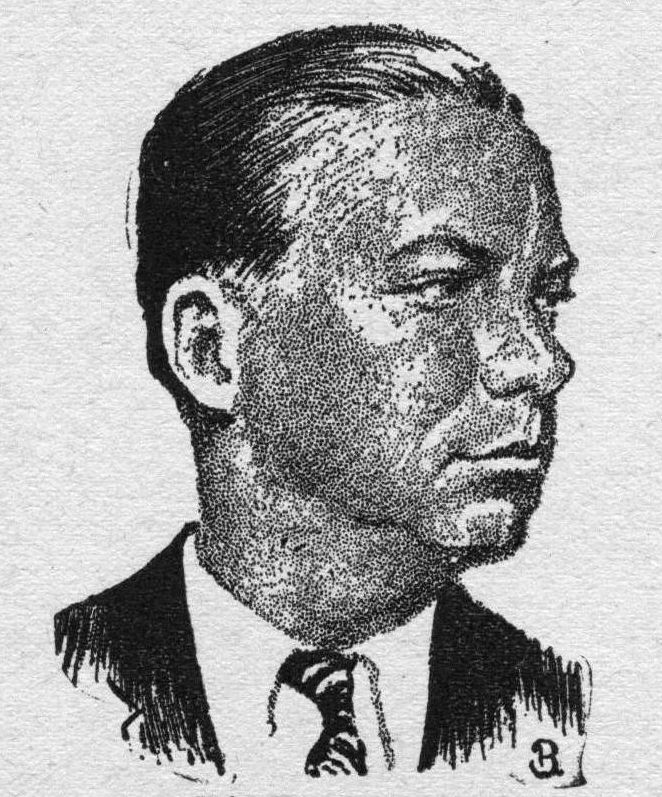
Harl Vincent: a Voice of Early Science Fiction
In the late 1920s, science fiction was still finding its magazine home. Hugo Gernsback’s Amazing Stories had given the field a flagship title, readers were hungry for moons, machines, and menaces, and a generation of working writers answered that hunger one pulp issue at a time. Among the names that turned up again and again was Harl Vincent: the byline of Harold Vincent Schoepflin, a mechanical engineer from Buffalo who became one of the reliable voices of American science-fiction pulp.
Vincent was not a literary celebrity in the modern sense. He was a working professional who wrote for magazines that paid by the word and lived or died by newsstand sales. That is part of why he still matters. His career maps the shape of early genre publishing: the Gernsback magazines, the rise of Astounding, the side markets in detective and spy pulp, a long silence, and a late return near the end of his life. For readers who want to understand how classic science fiction felt on the page when it was new, Vincent is a useful guide.
From Buffalo to Westinghouse
Harold Vincent Schoepflin was born in Buffalo, New York, on October 19, 1893. He attended a technical high school and enrolled at Rensselaer Polytechnic Institute, then left without finishing his freshman year in order to marry Ruth Hoff. They had two children, a son and a daughter. Professionally he worked as a mechanical engineer for Westinghouse, specializing in the installation and testing of large electrical apparatus. Later he moved into sales engineering and became manager of a local steam division.
That background shows up in the texture of his fiction. Vincent’s stories often treat technology as something a competent person can install, test, break, and repair. He came to writing after reading Gernsback’s Amazing Stories, which mixed scientific speculation with adventure. An engineer who already spent his days around heavy electrical gear was well placed to invent futures full of apparatus, power systems, and mechanical threat.
Breaking into Amazing Stories
Vincent’s first published story, “The Golden Girl of Munan,” appeared in the June 1928 issue of Amazing Stories. It opened what became the Professor Nilsson series and was followed in January 1929 by “The War of the Planets” in the same magazine. The Science Fiction Encyclopedia notes that “War of the Planets” includes an early, and perhaps the first, genre-sf use of the term “videophone”: a small but telling example of how pulp writers were inventing the everyday furniture of future communication while they invented their plots.
Over roughly the next fourteen years he published more than seventy science-fiction stories. Most of that work appeared in the dedicated science-fiction pulps, though he also placed fiction twice in Argosy, the general-fiction pulp, including the serial “Red Twilight.” Magazines such as Amazing Stories, Amazing Stories Quarterly, Science Wonder Stories, Air Wonder Stories, Astounding Stories (later Astounding Science-Fiction), Marvel Science Stories, Astonishing Stories, Super Science Stories, Captain Future, and Comet Stories all carried his byline at one point or another. He was, in short, a working pulp regular: prolific, adaptable, and visible across the field’s early prime.
Series Worlds and Favorite Menaces
Vincent liked linked series as much as one-shots. Wikipedia’s works list groups his stories into several cycles that give a clear sense of his range.
The Professor Nilsson pair begins with his debut and continues into planetary conflict. Professor Timkin appears in the longer Amazing Stories Quarterly pieces “Venus Liberated” (Summer 1929) and “Faster Than Light” (Fall/Winter 1932). The Subterrania stories, “The Menace from Below” (Science Wonder Stories, July 1929) and “The Return to Subterrania” (April 1930), show what the Science Fiction Encyclopedia calls his predilection for underground-menace tales. In the first, a mad scientist plans to uplift a subterranean ape-like species by transferring parts of human brains into their minds; the sequel attempts amends by way of the fourth dimension. Overcomplicated, vigorous, and thoroughly pulp, they are classic Vincent.
The Callisto pair, “The Explorers of Callisto” and “Callisto at War” (Amazing Stories, February and March 1930), takes readers into Jovian-moon adventure. Carr Parker stars in “Vagabonds of Space” (Astounding Stories of Super-Science, November 1930) and “Creatures of Vibration” (Astounding Stories, January 1932). The Purple and Gray cycle includes “Gray Denim” (December 1930), “Power” (Amazing Stories, January 1932), and the later “Master Control” (Astonishing Stories, April 1940). Ridge Coler appears in “Water-Bound World,” “When the Comet Returned,” and “Lost City of Mars.” The Prowler stories, “Prowler of the Wastelands” (Astounding Stories, April 1935) and “Return of the Prowler” (November 1938), close out the main series groups.
Alongside those cycles sit dozens of non-series tales. “Barton’s Island” was the cover story of the August 1929 Amazing Stories. Titles such as “The Copper-Clad World,” “Wanderer of Infinity,” “Vulcan’s Workshop,” “The Moon Weed,” and “Rex” show how wide his inventiveness ran: planetary shells, infinity travel, workshops of power, lunar weeds, and machine intelligence. “Rex” (Astounding Stories, June 1934) later found a second life in robot and monster anthologies edited by Sam Moskowitz, Isaac Asimov and colleagues, and others, which helped keep Vincent’s name visible after the pulp era had faded.
Among Peers: “The Challenge from Beyond”
In September 1935, Fantasy Magazine published the round-robin story “The Challenge from Beyond,” with sections by Stanley G. Weinbaum, Donald Wandrei, E. E. Smith, Harl Vincent, and Murray Leinster. Sharing that byline places Vincent among the working professionals of the decade’s science-fiction community, not as a fringe hobbyist but as a writer editors trusted to carry a collaborative feature. His fiction, as John Clute notes in the Science Fiction Encyclopedia, was “vigorous but ultimately disorganized”: fair as criticism, and also a description of what many pulp readers wanted. Energy, incident, and invention often mattered more than architectural neatness.
Detective and Spy Pulp
Vincent also stepped outside science fiction. In 1939–1941 he placed crime and spy stories in the detective pulps: “Condenser Pit Murder” (Detective Fiction Weekly, December 23, 1939), “The Stool at the Bar” (Thrilling Detective, March 1940), “Alibi Mike” (Detective Novels Magazine, June 1940), “Crime by Chart” (Exciting Detective, March 1941), and “Terror in Niagara” (Thrilling Spy Stories, Spring 1940). Those titles matter for a full picture of his career. Pulp markets rewarded writers who could shift registers without losing narrative drive, and Vincent’s detective work sits beside the science-fiction list as evidence of that flexibility.
Silence, Los Angeles, and a Late Return
Publication tapered off in the early 1940s. Vincent did not disappear from the field’s social world. After relocating to Los Angeles, he joined the Los Angeles Science Fantasy Society and the Count Dracula Society and attended local science-fiction conventions. Decades after his magazine peak, he returned to print with the novel The Doomsday Planet (Tower Books, 1966), a planetary romance in which a mysterious world draws travelers into its coils, and with the short story “Invader” in the September 1967 issue of If. A few further appearances followed around the end of his life, including “The Lethal Planetoid” in Spaceway (January 1969) and “Space Storm” in Famous Science Fiction (Spring 1969). He died in Los Angeles on May 5, 1968, of complications from emphysema and pneumonia. Forrest J. Ackerman memorialized him in Nebula Award Stories Four.
How to Read Him Now
Little of Vincent’s shorter work reached book form during his lifetime, aside from items such as the 1946 chapbook Master of Dreams. The twenty-first century has been kinder to his bibliography. Collections and double novels from Resurrected Press, Wildside Press, Armchair Fiction, and others have brought stories such as The Copper-Clad World, Microcosmic Buccaneers, Barton’s Island, War of the Planets, the Subterrania fixup, and Harl Vincent Resurrected back into print. Selected reprints associated with Villainous Press in the 2010s have also helped keep stories available beyond fragile pulp paper.
If you are new to his work, start with “The Golden Girl of Munan,” the story that introduced him, then try “War of the Planets” for the Nilsson sequel and that early “videophone.” From there, sample a series: Subterrania for underground menace, Callisto for moon war, Carr Parker for space vagabondage, or Purple and Gray for power-and-control intrigue. “Barton’s Island,” “Wanderer of Infinity,” and “Rex” are strong non-series entry points. The 1939–1941 detective shorts are a short side path for readers curious about his crime-pulp voice. The Doomsday Planet is the one novel: late-career planetary romance from a writer who had already spent decades inventing worlds for the magazines.
Why He Still Matters
Harl Vincent will not displace the field’s most anthologized giants, and he does not need to. His value is different. He shows what classic science fiction looked like when it was a working magazine trade: engineers who wrote at night, series that spilled across issues, gadgets named before the culture had words for them, and stories that preferred vigor to polish. Read him for the texture of the Gernsback and early Astounding years. Read him for the pleasure of pulp invention. Read him because the archive of early science fiction is richer when its reliable professionals stay visible beside its famous innovators.
This site exists to keep that visibility: the engineer from Buffalo, the pulp regular who built series worlds issue by issue, the occasional detective-story craftsman, and the late-career novelist who came back once more before the end. Open a story the way a 1930s newsstand reader would have, and meet Harl Vincent on the page.
Sources
- Wikipedia: Harl Vincent
- Science Fiction Encyclopedia: Vincent, Harl
- Bleiler, Everett F., and Richard Bleiler. Science Fiction: The Gernsback Years. Kent State University Press, 1998. (Cited via Wikipedia.)
- Ackerman, Forrest J. “In Memoriam: Harl Vincent.” In Nebula Award Stories Four, edited by Poul Anderson. Doubleday, 1969. (Cited via Wikipedia.)
- “Meet the Authors.” Amazing Stories, December 1938, p. 144. (Cited via Wikipedia.)