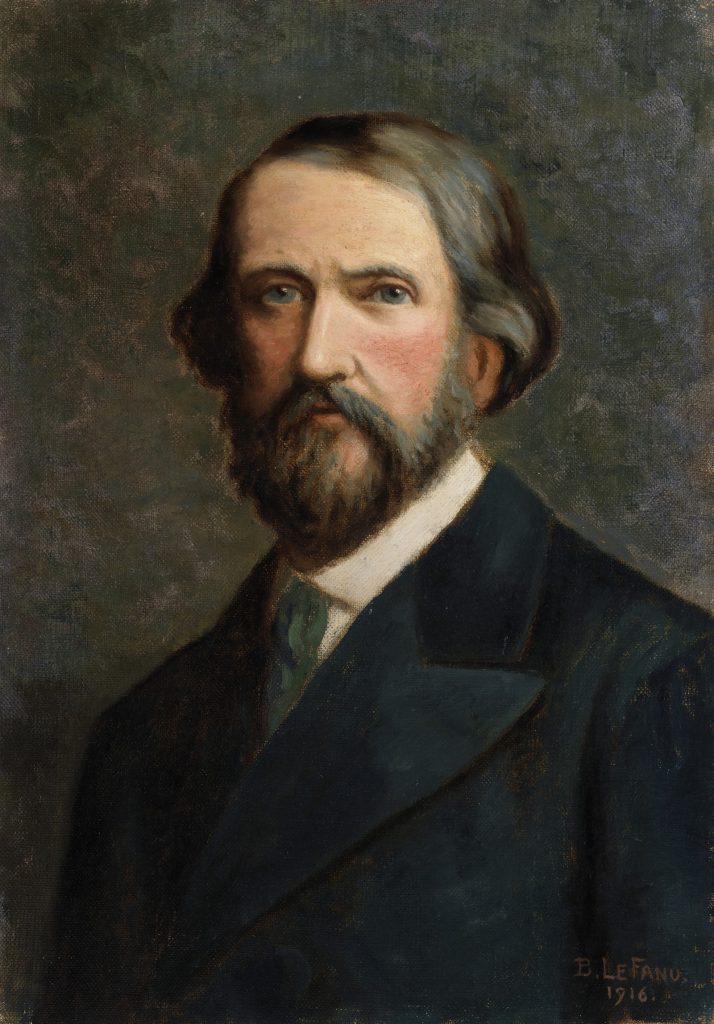
Sheridan Le Fanu: The Dublin Master of the Victorian Ghost Story
Twenty-five years before Bram Stoker sent Jonathan Harker to Transylvania, a quiet Dublin newspaperman published a story about a lonely girl in a Styrian castle and the beautiful, languid guest who came to stay. The guest slept through the mornings, never joined the family at prayers, and grew more affectionate as the girl grew weaker. The story was Carmilla, and its author was Joseph Thomas Sheridan Le Fanu.
M. R. James, who knew something about the subject, called Le Fanu “absolutely in the first rank as a writer of ghost stories.” Yet many horror readers know Carmilla better than the man who wrote it. His life held Irish history, a literary family, grief, and long nights of writing, and his fiction taught later writers how to frighten a reader without showing too much.
A Dublin childhood among writers
Le Fanu was born on August 28, 1814, on Dominick Street Lower in Dublin. His father, Thomas Le Fanu, was a Church of Ireland clergyman. His mother, Emma Lucretia Le Fanu, was a writer too. The family was middle-class, Protestant, and of French Huguenot descent. His grandmother, Alicia Sheridan Le Fanu, wrote plays, and his great-uncle was Richard Brinsley Sheridan, author of The School for Scandal.
Within a year of his birth, the family moved to the Royal Hibernian Military School in Phoenix Park, where his father became chaplain. The park and the nearby village of Chapelizod stayed in his imagination for life. In 1826 the family moved to Abington in County Limerick. The boys had a tutor who, according to his brother William, taught them nothing, so young Joseph taught himself from his father’s library. By fifteen he was writing poetry.
Those Limerick years were not peaceful. The Tithe War of the early 1830s, a revolt by the Catholic majority against compulsory payments to the Protestant church, reached the Abington area. Scholars have long read Le Fanu’s fiction as shaped by that divided Ireland, where an Anglo-Irish Protestant minority lived among a Catholic majority whose folklore and grievances surrounded them.
Law, journalism, and the Purcell Papers
Le Fanu studied law at Trinity College Dublin and graduated in 1836. He was called to the bar in 1839 but never practised. Writing pulled harder.
In January 1838 he published his first story, “The Ghost and the Bone-Setter,” in the Dublin University Magazine, a comic reworking of an Irish folk tale. Over the next few years he published a dozen tales presented as the papers of Father Francis Purcell, an eighteenth-century Catholic priest. Gathered much later as The Purcell Papers (1880), they range from playful to genuinely chilling. “Strange Event in the Life of Schalken the Painter” (1839) still appears in anthologies. A young woman in seventeenth-century Holland is given in marriage to a grey-faced suitor who turns out to be something worse than a rich old man. M. R. James called it “one of the best of Le Fanu’s good things.”
Another Purcell tale, “Passage in the Secret History of an Irish Countess,” held the seed of a novel he would write a quarter century later. Le Fanu reused ideas all through his career, reworking short stories into longer books.
From 1840 he owned several Dublin newspapers, including the Dublin Evening Mail. His early novels were Irish historical romances in the manner of Sir Walter Scott, such as The Cock and Anchor (1845). They did not sell especially well.
Marriage, grief, and “The Invisible Prince”
In 1844 Le Fanu married Susanna Bennett, the daughter of a leading Dublin barrister, and they had four children. Some sources date the marriage to 1843. After her father died in 1851, Susanna struggled with anxiety and a crisis of faith. In April 1858 she died after what was described as a “hysterical attack,” in circumstances that remain unclear. Le Fanu’s diaries suggest guilt as well as grief. He withdrew so completely from society that he earned the nickname “The Invisible Prince,” and he published no fiction until after his mother’s death in 1861.
The great decade
In 1861 he bought the Dublin University Magazine and became its editor and proprietor. He could now serialise a novel in his own pages and then revise it for the London book trade.
The House by the Churchyard (1863) came first. Set in eighteenth-century Chapelizod, it blends historical novel, murder mystery, and ghost story. James Joyce later drew on it in Finnegans Wake. Reviews were lukewarm, and his London publisher, Richard Bentley, wanted future novels set in England and in modern times.
Le Fanu obliged with his masterpiece of suspense. Uncle Silas (1864) expands that old Purcell tale and moves it to Derbyshire. Maud Ruthyn, a young heiress, is placed in the care of her uncle Silas, a shadowy man with a scandalous past who lives in a decaying house called Bartram-Haugh. The novel contains little open supernatural horror. Its terror comes from confinement, money, and the slow realisation that the people who should protect her may want her dead. Critics also count it an early locked-room mystery.
Sensation novels in the vein of Wilkie Collins followed, among them Wylder’s Hand (1864) and The Wyvern Mystery (1869). These paid the bills. His shorter supernatural fiction carried his deepest gifts.
“Green Tea” and the casebook of Dr. Hesselius
In 1869 Le Fanu published “Green Tea” in Charles Dickens’s magazine All the Year Round. The Rev. Mr. Jennings, a gentle scholar, begins to see a small black monkey with glowing eyes. It follows him everywhere and eventually urges him toward terrible acts. Is the creature a symptom of overwork and too much strong tea, a hallucination, or a demon? Le Fanu never settles it, and that uncertainty is the source of the dread.
In 1872 he gathered “Green Tea” with four other tales in In a Glass Darkly, framing them as cases from the papers of Dr. Martin Hesselius, a physician who studies the border between medicine and the spirit world. Many critics count Hesselius as the first occult detective in literature. The collection includes “The Familiar,” which M. R. James reportedly considered the best ghost story ever written, and “Mr Justice Harbottle,” about a cruel hanging judge who faces his own trial.
The fifth story was Carmilla.
Carmilla and the vampire before Dracula
Carmilla first ran as a serial in the London magazine The Dark Blue from December 1871 through March 1872, with illustrations by David Henry Friston and Michael Fitzgerald.
The narrator, Laura, lives with her father in a remote castle in Styria. A carriage accident brings a mysterious girl named Carmilla into their home, and Laura recognises her from a dream she had at six. Carmilla is charming, secretive, and openly affectionate. Laura dreams of a cat-like beast that pierces her breast, and her health declines. A restored portrait of the Countess Mircalla Karnstein, dated 1698, matches Carmilla exactly. The story ends in a ruined chapel and an opened tomb.
Le Fanu drew on Dom Augustin Calmet’s eighteenth-century treatise on vampires, and critics have noted echoes of Coleridge’s “Christabel.” What he made from them was new: a vampire with feelings, a story told by her victim, and an intimacy between two young women that scholars still discuss. Carmilla became the literary prototype of the female vampire.
Its influence on Bram Stoker, another Dublin Protestant educated at Trinity College, is widely recognised. Both stories use first-person narration. Carmilla and Stoker’s Lucy both sleepwalk. Le Fanu’s vampire scholar, Baron Vordenburg, anticipates Abraham Van Helsing. Stoker’s “Dracula’s Guest,” often described as a deleted opening of Dracula, is even set in Styria. Film took up the tale too, from Carl Theodor Dreyer’s Vampyr (1932) to Hammer’s The Vampire Lovers (1970).
Last years and a long afterlife
Le Fanu died in Dublin on February 7, 1873, at fifty-eight. Accounts differ. His daughter Emma said he died peacefully after bronchitis, while other sources cite a heart attack. A later legend claimed he died of fright, which says more about his readers than about the facts.
His reputation faded after his death. The revival came from writers who loved him. In 1923 M. R. James edited Madam Crowl’s Ghost and Other Tales of Mystery, which helped bring Le Fanu back into print, and Elizabeth Bowen championed Uncle Silas. Today he is studied as a central figure in Irish Gothic.
His method has lasted because it works. He rarely explains everything. The monkey in “Green Tea” may be a delusion, and the deaths in “The Familiar” are never witnessed directly. Horror filmmakers later called a similar approach “indirect horror.”
How to start reading Le Fanu
Begin with In a Glass Darkly. “Green Tea” takes about an hour and shows his psychological horror at its sharpest. Read Carmilla next, ideally on a dark evening. Then try “Schalken the Painter” for his early Irish Gothic voice.
If you want a full novel, choose Uncle Silas. It is leisurely in the Victorian manner, but the second half tightens like a noose. For more short fiction, Madam Crowl’s Ghost gathers the stories M. R. James loved, including “Sir Dominick’s Bargain.” Nearly all of it is in the public domain, and Project Gutenberg offers free texts.
Sheridan Le Fanu wrote as a grieving man who preferred his own company. From that solitude came the first great female vampire, the first occult detective’s casebook, and ghost stories that still unsettle readers a century and a half later.
Sources
- Wikipedia: Sheridan Le Fanu
- Wikipedia: Carmilla
- Wikipedia: Uncle Silas
- Cooke, Simon. “An Introduction to the Life and Work of J. S. Le Fanu.” The Victorian Web.
- “Joseph Sheridan Le Fanu.” Oxford Bibliographies in Victorian Literature. Oxford University Press.
- McCormack, W. J. “Le Fanu, (Joseph Thomas) Sheridan (1814-1873), novelist and newspaper proprietor.” Oxford Dictionary of National Biography, 2008. doi:10.1093/ref:odnb/16337. (Cited via Wikipedia; subscription required.)
- Maume, Patrick. “Le Fanu, Joseph Thomas Sheridan.” Dictionary of Irish Biography, 2009. (Cited via Wikipedia.)
- McCormack, W. J. Sheridan Le Fanu. 3rd ed. Sutton Publishing, 1997. (Cited via Wikipedia.)
- Sullivan, Jack, ed. The Penguin Encyclopedia of Horror and the Supernatural. Viking, 1986. (Cited via Wikipedia.)
- James, M. R., ed. Madam Crowl’s Ghost and Other Tales of Mystery. G. Bell and Sons, 1923.
- Project Gutenberg texts: Carmilla; Uncle Silas; The House by the Church-Yard; In a Glass Darkly, vol. 1; The Purcell Papers, vol. 1.
- Wikimedia Commons: Portrait by Brinsley Le Fanu; D. H. Friston Carmilla illustration.