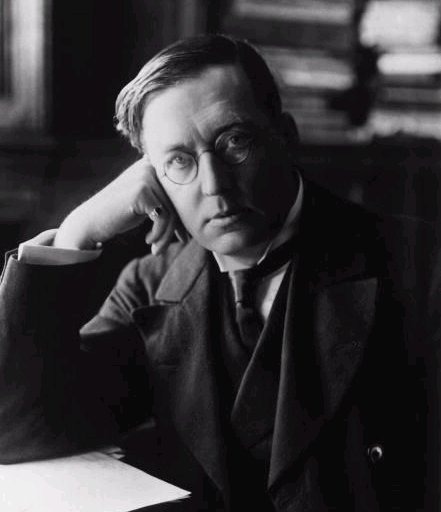
M. R. James: The Cambridge Scholar Who Perfected the Antiquarian Ghost Story
On the evening of October 28, 1893, ten members of a Cambridge club called the Chitchat Society gathered in the rooms of a young King’s College don. The society usually heard scholarly papers. That night their host read them two ghost stories instead. One followed an English tourist who buys an old scrapbook in a French cathedral town and finds something drawn on its last page. The other concerned a lonely orphan sent to live with an elderly cousin who takes an unusual interest in children’s hearts.
The stories became “Canon Alberic’s Scrap-Book” and “Lost Hearts.” The host was Montague Rhodes James, a medieval scholar who would become one of the most respected academics in England. Today he is far better known for the thirty-odd ghost stories he wrote on the side, and many critics rank them the finest in the language.
A rectory childhood and an Eton education
James was born on August 1, 1862, in a clergy house at Goodnestone in Kent. His father, Herbert James, was an Evangelical Anglican clergyman, and his mother, Mary Emily Horton, was the daughter of a naval officer. When he was three, the family moved to the rectory at Great Livermere in Suffolk. That house remained his home base until 1909. Several of his best tales are set on its coast and in its villages.
He went to Eton College in 1876 and showed an early gift for languages. He claimed to have translated the apocryphal Book of Baruch from Ethiopic while still a schoolboy. In 1882 he went up to King’s College, Cambridge, and he stayed there for most of the next thirty-six years.
The scholar behind the stories
James was a serious scholar first. He catalogued the medieval manuscript collections of many Cambridge colleges, a vast labor that specialists still consult. He translated the New Testament apocrypha. In 1902 he found a manuscript clue that led excavators at the ruined abbey of Bury St Edmunds to the lost graves of several twelfth-century abbots.
His career climbed steadily. He directed the Fitzwilliam Museum in Cambridge from 1893 to 1908. He served as Provost of King’s from 1905 to 1918 and as Vice-Chancellor of the university from 1913 to 1915. In 1918 he returned to Eton as its Provost, a post he held until his death. He received the Order of Merit in 1930.
That learning fed the fiction directly. James knew how old books smelled, how cathedral archives were arranged, and how a Latin inscription might read on a worn object.
Ghost stories at Christmas
After that first Chitchat reading, James made storytelling a habit. He wrote new tales as Christmas entertainments and read them aloud to friends and chosen students at Cambridge and later at Eton. He was a gifted performer.
A friend helped bring the stories into print. James McBryde, a younger artist in his circle, drew four plates for a planned book. McBryde died suddenly in June 1904, at about thirty, after an operation for appendicitis. James chose to publish only those four illustrations as a tribute rather than hire another artist. Ghost Stories of an Antiquary appeared from Edward Arnold later that year with eight tales, including “Canon Alberic’s Scrap-Book,” “Lost Hearts,” “The Mezzotint,” “Count Magnus,” and “Oh, Whistle, and I’ll Come to You, My Lad.”
Three more collections followed: More Ghost Stories of an Antiquary (1911), A Thin Ghost and Others (1919), and A Warning to the Curious and Other Ghost Stories (1925). The Collected Ghost Stories of M. R. James followed in 1931.
The antiquarian method
James wrote the way he read old documents, with patience and precision. A typical Jamesian tale opens with a quiet, rather naive scholar or gentleman on holiday or at work. He stays in an English seaside town, a country house, a cathedral close, or an old town in France or Scandinavia. He finds an old object, such as a book, a whistle, a print, or a buried crown. And the object draws the attention of something that should have stayed asleep.
He explained his recipe in a foreword to the anthology Ghosts and Marvels. “Two ingredients most valuable in the concocting of a ghost story are, to me, the atmosphere and the nicely managed crescendo,” he wrote. The reader should meet the characters “going about their ordinary business,” and then “let the ominous thing put out its head, unobtrusively at first, and then more insistently, until it holds the stage.”
He also had firm rules about ghosts. He wanted them “malevolent or odious,” not friendly. And he wanted the reader to think, “If I’m not very careful, something of this kind may happen to me!”
His great tool was reticence. He rarely shows the whole horror. He offers a glimpse, a texture, or a shape seen at a distance, and the reader’s mind does the rest. Yet he was never mild. His creatures are hairy, bony, and damp, and the moments when one touches a character are hard to forget.
Four tales to know
“Oh, Whistle, and I’ll Come to You, My Lad” (1904) follows Parkins, a skeptical Cambridge professor on a golfing holiday at Burnstow, a thinly disguised Felixstowe. Exploring a ruined Templar preceptory, he finds a bronze whistle inscribed “Quis est iste qui venit,” Latin for “Who is this who is coming?” He blows it. The answer arrives in the empty second bed of his hotel room, and James makes a rumpled bedsheet the stuff of nightmares.
“The Mezzotint” (1904) concerns Mr. Williams, a university museum curator who buys an ordinary engraving of a manor house. Each time he and his friends look at it, the picture has changed. A figure appears on the lawn, crawls toward the house, and then leaves carrying something. Paul Theroux called it “the most frightening story I know.”
“Casting the Runes” (1911) is James’s most plotted tale. Edward Dunning, a scholar who recommended rejecting a paper by the occultist Karswell, is slipped a strip of paper covered in runes. Strange signs follow, and he learns that another critic of Karswell died three months after a similar gift. Dunning’s only hope is to hand the runes back before his time runs out. T. E. D. Klein put it first on his list of the most terrifying horror stories.
“A Warning to the Curious” (1925) may be his bleakest. An amateur antiquary named Paxton, holidaying at Seaburgh, a stand-in for Aldeburgh, digs up one of the legendary lost crowns of East Anglia, said to guard England from invasion. Something has guarded the crown for a long time, and it does not let him go. Written after the First World War, the story carries a weight of loss that his early tales lack.
Influence on later horror
Writers noticed James quickly. H. P. Lovecraft praised his stories in the essay “Supernatural Horror in Literature” (1927). A circle of British writers, sometimes called the “James Gang,” wrote ghost stories in his manner, among them E. G. Swain, A. N. L. Munby, and R. H. Malden. Stephen King discussed him in Danse Macabre, and Ramsey Campbell edited Meddling with Ghosts, an anthology of stories in the Jamesian tradition. James himself championed an earlier master. He called Sheridan Le Fanu “absolutely in the first rank as a writer of ghost stories” and edited a collection of his tales in 1923.
The screen kept him alive for new generations. Jacques Tourneur turned “Casting the Runes” into Night of the Demon (1957), still counted among the great horror films. In 1968 Jonathan Miller adapted “Whistle and I’ll Come to You” for the BBC, with Michael Hordern as Parkins. From 1971 the BBC’s A Ghost Story for Christmas adapted five James stories, beginning with The Stalls of Barchester and including Lawrence Gordon Clark’s chilling A Warning to the Curious (1972). The strand returned in 2005, and Mark Gatiss has since adapted “The Mezzotint” (2021) and “Count Magnus” (2022). In 2000 Christopher Lee played James reading his stories by candlelight at King’s.
Those films helped make James a founding figure of folk horror. Critic Jon Dear has called him “the go-to folk horror writer” for television. His lonely coastlines, buried relics, and curious scholars run straight into modern weird fiction.
Last years
James spent his final eighteen years at Eton, the school he loved. He never married. When his friend McBryde died, James became guardian to McBryde’s infant daughter, Jane, and his letters to her and her mother appeared in 1956 as Letters to a Friend. He died at Eton on June 12, 1936, at seventy-three, and was buried in the town cemetery there.
How to start reading M. R. James
Start with Ghost Stories of an Antiquary. Read “Oh, Whistle, and I’ll Come to You, My Lad” first, then “The Mezzotint” and “Count Magnus.” Move on to “Casting the Runes” in More Ghost Stories of an Antiquary, and save “A Warning to the Curious” for a foggy night.
Read them aloud if you can, the way James first shared them. His four original collections are in the public domain, and Project Gutenberg and Standard Ebooks offer free texts. Readers who want everything can look for A Pleasing Terror, the complete supernatural writings from Ash-Tree Press, or S. T. Joshi’s annotated Penguin Classics editions.
More than a century after that night in his rooms at King’s, M. R. James still sends readers to bed checking the empty side of the room.
Sources
- Wikipedia: M. R. James
- Wikipedia: Ghost Stories of an Antiquary
- Wikipedia: More Ghost Stories of an Antiquary
- Wikipedia: A Thin Ghost and Others
- Wikipedia: Canon Alberic’s Scrap-Book
- Wikipedia: “Oh, Whistle, and I’ll Come to You, My Lad”
- Wikipedia: The Mezzotint
- Wikipedia: Casting the Runes
- Wikipedia: A Warning to the Curious
- Wikipedia: Adaptations of works by M. R. James
- Wikipedia: A Ghost Story for Christmas
- Wikipedia: Night of the Demon
- Pardoe, Rosemary. “M. R. James Chronological Story Listing.” Ghosts & Scholars, 2007.
- “Thrillingly creepy tales of ghosts and ghouls.” The Telegraph. (Chitchat Society reading of October 28, 1893.)
- Kraft, Robert A. “MRJ Talk.” University of Pennsylvania.
- “Ghosts of the Chit-Chat.” Swan River Press.
- James, M. R. Foreword to V. H. Collins, ed., Ghosts and Marvels. Oxford University Press, 1924. (Quoted via Wikipedia.)
- Cox, Michael. M. R. James: An Informal Portrait. Oxford University Press, 1983. (Cited via Wikipedia.)
- Lovecraft, H. P. “Supernatural Horror in Literature,” 1927. (Cited via Wikipedia.)
- Free texts: Project Gutenberg, M. R. James author page; Ghost Stories of an Antiquary; Standard Ebooks, M. R. James short fiction.
- Wikimedia Commons: M. R. James, c. 1900; McBryde “Whistle” illustration, 1904; A Thin Ghost cover, 1919.