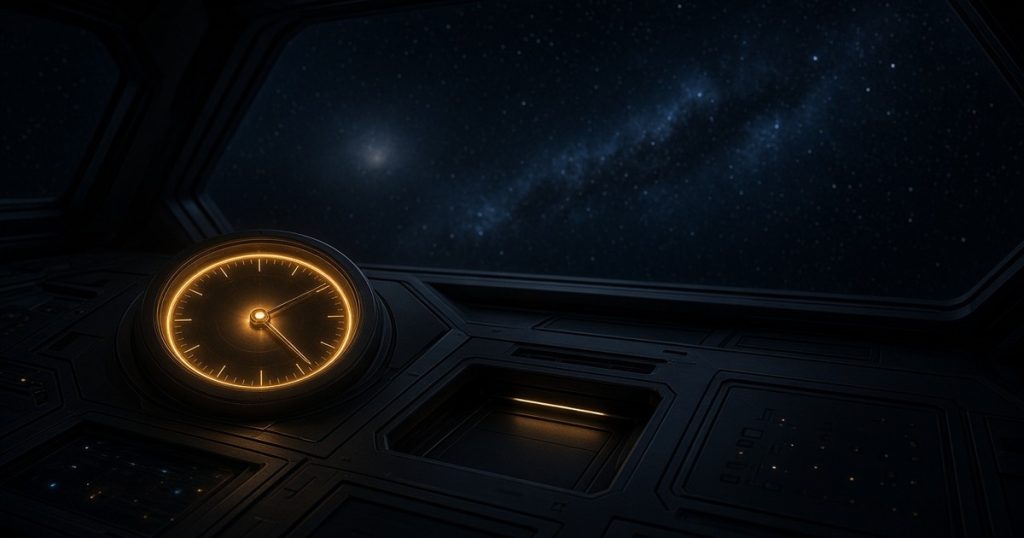
Ticking Clock Storytelling: How to Create Tension in Science Fiction
How can you tell when a clock is really tense? When it’s all wound up.
If you want better tension in science fiction, start with ticking clock storytelling. Put a hard limit on your characters (air, fuel, a star about to go nova, a plague already loose on the ship) and make the cost of missing it hurt. Space is big, cold, and does not care about your hero. That is free pressure. Your job is to start the clock and then make the crew sweat. Or explode.
Newer writers often hear “ticking clock” and picture only a bomb timer. Fine trope. The idea goes further than that, especially in SF.
What is ticking clock storytelling?
Ticking clock storytelling means something is limited or constrained, and the characters must deal with it or face serious (often dire) consequences. You can build the whole plot around one clock, or drop a smaller one into a single scene where they have to finish something right now.
The clock does not have to be an actual clock. It only has to be a limit the reader can feel shrinking.
Why tension in science fiction loves a ticking clock
Tension in science fiction thrives when the environment itself is counting down. SF hands you limits other genres have to invent:
- Life support. Oxygen, water, heat, radiation shielding.
- Fuel and power. Burn hard for only so long, then you coast.
- Physics. Orbits decay. Launch windows close. A message to Earth takes as long as light allows.
- Biology. Plagues, parasites, cryosleep that cannot safely stop early.
- Stellar events. Flares, storms, a sun about to go boom.
One warning: SF readers will check your math. If the clock runs on physics, keep the physics consistent with your setting. Nail those rules before you start the countdown. My post on world-building tools for authors and game masters can help you track them. A clock the reader does not believe is not a clock. It is a stopwatch somebody forgot to start.
SF case study: plague ship, disputed sector, sun going nova
Here is the science-fiction example from my original post, built out so you can see how clocks stack in space.
A captain must reach a planetary system in a disputed sector to rescue a plague research team, because the local sun will go nova. That is clock one: a hard stellar deadline. The star does not negotiate. Arrive late and the team dies, along with anyone still in orbit.
On the way, someone drops a vial and catches the plague. Clock two: a biological countdown already running inside the crew. Nobody knows exactly how much time is left. Every cough on the bridge makes the reader flinch.
Clock three: the sector is disputed. Somebody else wants that system, or wants the captain gone. Every fight costs time the crew does not have. A good antagonist here is not only an obstacle. They are a thief stealing minutes. (If your opposition feels flat, see my post on villains.)
The captain is juggling three questions:
- Can they reach the team before the sun goes boom?
- Can they find a cure before they all die?
- Can they get past enemies quickly enough to still save the team?
The clocks squeeze each other. The research team may be the best hope for a cure, which makes the nova deadline matter more. Fighting burns fuel and time, which shortens the other clocks. Every choice that helps one clock hurts another. That is where the tension lives.
Ways to put that on the page:
- Show the clock. Do not announce it. A hand that cannot hold a stylus steady. A star brighter on the viewscreen every time you cut back. A fuel readout nobody wants to look at. Readers feel those more than “We have six hours.” More on that in show, don’t tell.
- Let the clocks interrupt each other. The cure breakthrough hits the same moment the enemy ship drops out of hyperspace. Of course it does.
- Tighten the prose as time runs down. Shorter sentences. Active verbs. Characters doing things, not things being done to them. Refresh: passive writing was avoided by the author.
Star Wars: ticking clocks inside ticking clocks
Re-watching the original Star Wars, with Carrie Fisher as Leia, is still a clean classroom for this.
Han, Chewie, and Luke must rescue Leia from the Death Star detention block because she is scheduled for execution. The clock is the time they have to get her out. Miss it and she dies.
Then Luke and Leia run from the guards and get trapped by the missing walkway. Under fire, Luke closes the door and blasts the controls, not thinking those controls may operate the retracted walkway. Stormtroopers work the door. That is the ticking clock. Escape or get shot. That is the consequence.
The bigger clock wraps the finale: the Death Star moving into range of the rebel base while the pilots make their attack run. One huge clock with smaller ones inside it.
Audiences sat on the edges of their seats in 1977 wondering if the heroes would make it. That is tension.
A non-clock countdown works the same way. In the old House on Haunted Hill with Vincent Price, guests must survive the night, and people die one by one. Swap the house for a research station or generation ship and the body count becomes your SF clock.
How to set up a ticking clock (four rules)
For writers learning plot tension, these four rules still carry the method:
- Something must actually be limited or constrained. Time, air, fuel, people, power. If it is unlimited, it is not a clock.
- The consequences of failing must be severe. Mild inconvenience does not make anyone sweat. Irrecoverable damage, death, or loss of a world does.
- Never give the protagonists a reprieve. Keep the pressure on and ramp it up. Do not let the star politely wait a few extra days.
- Give the audience a payoff when (and if) they succeed. After all that pressure, readers need an emotional release. Let them exhale.
Setting up a ticking clock is especially useful for beginning writers because it gives the reader one clear question that needs an answer.
Common mistakes with ticking clocks in SF
Avoid these traps:
- A soft deadline. “Sometime soon” is not a clock. Name the constraint the reader can track.
- A clock with no teeth. If missing it costs nothing that matters, cut it or raise the stakes.
- The miracle reprieve. The fuel tank that “turns out” to have a reserve, the nova that mysteriously waits, the plague that conveniently pauses. Readers feel cheated.
- Announcing instead of showing. Do not lean only on “We have four hours.” Show the shrinking resource on the page.
- Broken physics. Inconsistent FTL, oxygen, or radiation rules kill trust faster than a slow scene. Once you set your world rules, they should never change.
- One clock that never interacts with anything else. Layer a second constraint so choices hurt.
Start the clock, make the stakes horrific, and do not let up. Your readers will thank you, right after they finish chewing their fingernails.
More craft notes live in my On Writing category.